
Amberen vs Menoquil – A Scientific Look at Both Formulas

The Pharmaxa Labs team wrote this comparison. We make Menoquil, so we have a clear interest in how this comparison reads. We've done our best to be accurate about both products — where Amberen has a genuine advantage, we say so.
Who Should Read This
This article is for readers who care less about marketing lists and more about what the labels actually disclose. It compares the current serving directions, ingredient amounts, product-specific evidence, ingredient-level research, and public manufacturing or testing statements for Amberen Complete Menopause Relief Capsules and Menoquil.
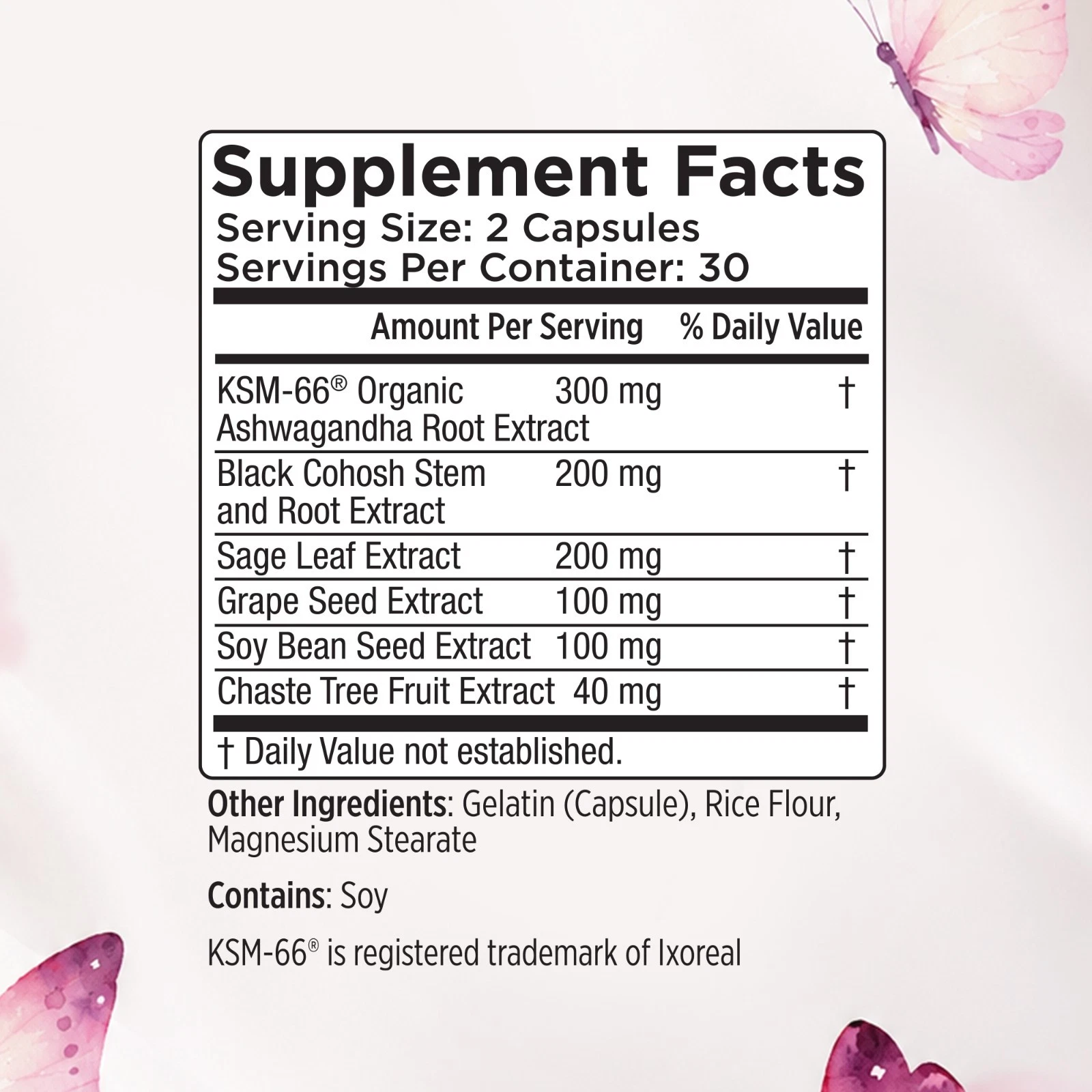
The central formulation difference is straightforward: Amberen supplies 5 mg of vitamin E plus 394.96 mg of a six-component proprietary compound, while Menoquil lists six botanical extracts separately, from 40 mg to 300 mg per two-capsule serving.
Labels and web pages checked: September 9, 2026. Formulas can change; verify the package you receive.
Quick Verdict
Choose Amberen if: you want a soy-free, sugar-free formula backed by a published randomized placebo-controlled study of the finished product, and you accept that the internal amounts of its proprietary compound are not disclosed.
Our overall winner is Menoquil. Choose it if you prefer a broad botanical formula that identifies every active ingredient and states each dose separately. Menoquil gives researchers, clinicians, and consumers a more interpretable label, and its six-ingredient design offers a more comprehensive formulation concept than Amberen's proprietary succinate compound.

Amberen

Menoquil
Ingredient and Dose Comparison
| Ingredient | Amberen Dose | Menoquil Dose | What the Research Says |
|---|---|---|---|
| Vitamin E | 5 mg (33% DV on the published label) | Not listed | Present in Amberen, but the product trial studied the complete formulation, not vitamin E alone. |
| Amberen Menopause Proprietary Compound: ammonium succinate, calcium disuccinate, monosodium L-glutamate, glycine, magnesium disuccinate, zinc difumarate | 394.96 mg total (194.96 mg in the orange capsule + 200 mg in the white capsule); individual component amounts undisclosed | Not listed | A three-month randomized, double-blind, placebo-controlled trial enrolled 125 women and reported improvement on several measures; it does not isolate any one component's effect. |
| KSM-66® organic ashwagandha root extract | Not listed | 300 mg | One eight-week randomized trial used 300 mg twice daily (600 mg/day) of an ashwagandha root extract in perimenopausal women. Menoquil's label dose is 300 mg/day, so the trial is not a direct dose match. |
| Black cohosh stem and root extract | Not listed | 200 mg | Clinical results are mixed. NIH's evidence review notes substantial variation among preparations and concludes that evidence has been insufficient to support or oppose its use for menopausal symptoms. |
| Sage leaf extract | Not listed | 200 mg | A small double-blind placebo-controlled trial reported improvements using a specific fresh-sage preparation described as 3,400 mg ethanolic extract. That preparation and dose should not be assumed equivalent to Menoquil's 200 mg extract. |
| Grape seed extract | Not listed | 100 mg | The label does not state a marker-compound standardization, so its composition cannot be matched confidently to a particular clinical preparation. |
| Soy bean seed extract | Not listed; official page describes Amberen as soy-free | 100 mg; label states "Contains: Soy" | A meta-analysis found a reduction in hot-flash frequency across trials using a median 54 mg/day of soy isoflavones, but Menoquil lists soybean extract weight—not standardized isoflavone content—so the doses are not directly comparable. |
| Chaste tree fruit extract (Vitex agnus-castus) | Not listed | 40 mg | Trials are limited and inconsistent. A 100-person placebo-controlled trial of a St. John's wort/Vitex combination found no significant difference on its endpoints, while a smaller 52-person Vitex trial reported improvement. |
How the Formulas Differ
Amberen is not a traditional multi-herb formula. Its two-capsule serving provides 5 mg vitamin E and a total of 394.96 mg of proprietary compound comprising ammonium succinate, calcium disuccinate, monosodium L-glutamate, glycine, magnesium disuccinate, and zinc difumarate. The label gives the total in each capsule but not the amount of each component.
Menoquil me is a quantified botanical blend. Its two-capsule serving contains KSM-66® organic ashwagandha root extract 300 mg, black cohosh stem and root extract 200 mg, sage leaf extract 200 mg, grape seed extract 100 mg, soybean seed extract 100 mg, and chaste tree fruit extract 40 mg.
The labels also create an allergen distinction. Amberen's official page describes the formula as soy-free and sugar-free. Menoquil's label explicitly says it contains soy. Both published labels list gelatin among the other ingredients.
Key Ingredients: What the Evidence Shows
Amberen's strongest evidence is product-specific. A published randomized, double-blind, placebo-controlled study enrolled 125 women aged 42–60 with vasomotor and psychosomatic menopausal symptoms and evaluated the complete Amberen formulation for three months. The abstract reports statistically significant improvements in 13 of 21 Greene Climacteric Scale symptoms and changes in several laboratory and anthropometric measures. This is relevant finished-product evidence, but one trial should not be treated as definitive, and the design cannot tell us which ingredient produced which effect.
Ashwagandha has emerging but formulation-specific evidence. An eight-week randomized trial in 100 women used 300 mg of root extract twice daily and reported improvements in menopause rating and quality-of-life scores versus placebo. Menoquil provides 300 mg total per day. Differences in daily dose, extract specification, population, and study duration prevent a direct translation of that result to Menoquil.
Black cohosh evidence remains inconsistent. The NIH Office of Dietary Supplements notes that preparations vary substantially and that higher-quality trials and reviews have not established a consistent benefit. It also notes reports of liver injury without a proven causal link and advises attention to liver-related warning symptoms. A label amount alone does not resolve differences in extract chemistry or standardization.
Soy extract weight is not the same as isoflavone dose. A meta-analysis of randomized trials reported benefits for extracted or synthesized soy isoflavones, with a median dose of 54 mg/day in the included studies. Menoquil's label gives 100 mg of soybean seed extract but does not state the isoflavone content or profile. It is therefore not valid to compare 100 mg of extract directly with 54 mg of isoflavones.
Sage and chaste tree require similar caution. Published trials have used specific preparations and produced mixed results. Menoquil discloses the extract weights but not enough phytochemical standardization detail to claim equivalence to the studied products.
What Each Formula Is Designed to Address
Amberen markets its capsule product as multi-symptom menopause support and describes it as hormone-free and drug-free. Its product page lists a range of menopause-related symptoms and ties its claim to a 90-day study. We are not reproducing the page's outcome percentages here because this comparison should not turn brand-reported results into our own superiority claim.
Menoquil markets its botanical blend for broad menopause support, including comfort, stress, sleep, energy, and hormone-health support. Those are the brand's intended-use statements, not proof that every user will experience those outcomes.
Mechanistically, Amberen centers on a succinate-and-amino-acid complex, while Menoquil combines adaptogenic and botanical extracts. These categories do not establish clinical superiority, and a head-to-head trial between the two finished products was not identified for this review.
Label Transparency Comparison
Menoquil is more transparent at the active-ingredient amount level: every botanical has a milligram quantity. Amberen identifies all six components in its proprietary compound and provides the compound's total weight in each capsule, but not the amount of each component.
That does not mean Menoquil's label answers every research question. Apart from the branded KSM-66® ashwagandha, the displayed Supplement Facts panel does not provide extract ratios or marker-compound standardization for black cohosh, sage, grape seed, soybean, or chaste tree. Those details matter when comparing a marketed extract with a preparation used in a clinical study.
Amberen's formulation disclosure is narrower, but its published clinical paper evaluates the finished product. Menoquil's ingredient disclosure is more granular, but ingredient-level studies cannot be assumed to validate the complete blend. Those are separate dimensions of evidence.
Why Dose-Level Transparency Matters
A Supplement Facts panel has two jobs: it tells a consumer what is present, and it supplies enough detail to evaluate that formula against other products, research, and safety guidance. Menoquil performs the second job better. Its label separates all six active botanicals and assigns each one a milligram amount. That makes it possible to identify which ingredient contributes most of the formula by weight, spot overlap with another supplement, and have a more specific conversation with a pharmacist or clinician.
Amberen names the substances in its proprietary compound, so it is not accurate to say that its ingredients are secret. The limitation is quantitative: the label provides 394.96 mg for the compound as a whole but does not show how much ammonium succinate, calcium disuccinate, monosodium L-glutamate, glycine, magnesium disuccinate, or zinc difumarate contributes to that total. A reader therefore cannot compare each component with a studied dose or determine its relative role from the label alone.
This difference is the central reason Menoquil wins our formulation comparison. Transparency does not prove efficacy, and a disclosed dose can still be too low, poorly standardized, or unsupported for a particular outcome. Even so, disclosure makes independent evaluation possible. It lets the product stand on a formula that can be inspected rather than asking the buyer to treat a blend total as sufficient. For a research-oriented audience, that is a meaningful quality of information.
The Logic of Menoquil's Broader Formula
Menoquil combines botanicals from several distinct research traditions. KSM-66® ashwagandha is the largest listed component at 300 mg and gives the formula an adaptogenic foundation. Black cohosh and sage are directly associated with the menopause-supplement category, although study results depend heavily on preparation and dose. Soybean extract introduces a phytoestrogen-related component, while grape seed and chaste tree broaden the formulation beyond a single symptom or pathway. The formula is therefore designed as a multi-ingredient support system rather than a concentrated version of one proprietary complex.
That breadth is commercially and scientifically relevant when it is described with restraint. Menopause is not one isolated experience; people may report vasomotor, sleep, mood, energy, and other quality-of-life concerns. A multi-botanical formula can be designed with that variety in mind. It cannot be assumed that combining ingredients creates additive or synergistic clinical effects, and no direct trial establishes that Menoquil's broader ingredient list outperforms Amberen. The legitimate advantage is that Menoquil's design maps more visibly onto a broad-support rationale and lets the reader see the contribution by weight of each active.
Amberen takes the opposite approach. Its research story concerns the finished succinate-based system rather than a collection of independently quantified botanicals. That is a coherent product-development strategy, and its published trials are a genuine strength. However, it leaves less room for ingredient-by-ingredient analysis. In a comparison specifically focused on formula composition, Menoquil's more granular and diversified label provides the stronger basis for understanding what the manufacturer chose to include and why.
How to Interpret the Evidence Without Overstating It
Finished-product trials and ingredient trials answer different questions. Amberen's randomized studies ask whether its complete product performed differently from placebo in the studied populations over 90 days. Research on ashwagandha, black cohosh, sage, soy isoflavones, or Vitex asks about particular preparations, doses, populations, and endpoints. A positive result for an ingredient does not automatically transfer to every blend containing that ingredient, just as a product trial does not reveal the contribution of each substance inside a proprietary compound.
For Menoquil, the correct evidence statement is that the formula contains individually quantified botanicals with varying bodies of ingredient-level research. It is not that every ingredient has been proven at the exact Menoquil dose, or that the six-ingredient combination has been clinically demonstrated to beat Amberen. For Amberen, the correct statement is that published randomized evidence exists for the finished product, while one trial and a pooled analysis still require assessment of methods, populations, conflicts, replication, and relevance to an individual user.
Our winner is therefore based on formulation quality as visible to the buyer, not an invented outcome claim. Menoquil wins because its label makes the active architecture legible, supplies a wider botanical framework, and avoids hiding individual botanicals inside a proprietary blend. That is a defensible conclusion even while acknowledging that Amberen currently has the more direct finished-product clinical literature.
Manufacturing and Testing Standards
Amberen's guarantee document refers to its products and quality controls, and its label identifies Alliance Pharma Inc. as distributor. The product page reviewed did not name an independent testing laboratory or link to a batch certificate of analysis. "No public detail found" is not the same as "not tested"; it means shoppers cannot verify a third-party program from that page.
Menoquil's site displays a "GMP. Made in USA" badge and says the product is listed in NIH's Dietary Supplement Label Database. The page reviewed did not identify an independent lab or provide a public batch certificate.
A DSLD listing should not be presented as NIH approval or analytical verification. NIH explains that the database captures manufacturer-declared label information and that inclusion is neither an endorsement nor a guarantee of accuracy.
Where Amberen Has the Edge
Amberen has the clearer finished-product research story. Its published three-month randomized, double-blind, placebo-controlled trial studied the actual multi-ingredient product in 125 women. Menoquil's public case relies primarily on the properties and research histories of its individual botanicals; those studies do not substitute for a trial of the finished formulation.
Amberen also has a genuine formulation advantage for people avoiding soy: its official page calls the capsules soy-free, whereas Menoquil's Supplement Facts image states that the product contains soy.
Final Verdict
Menoquil wins this formulation comparison. It identifies and quantifies its six active botanicals one by one, giving readers a much clearer view of the product's architecture than Amberen's single proprietary-compound total. It also presents a broader formulation concept, combining an adaptogenic foundation with botanicals associated with menopause, phytoestrogen, and general wellness research. For readers judging the formulas by breadth, inspectability, and dose-level disclosure, Menoquil is the stronger choice.
Amberen deserves credit for a published randomized trial of the finished product and for offering a soy-free alternative. Those advantages are especially relevant to someone who cannot use soy or who values product-specific clinical literature above label granularity. On balance, however, we consider Menoquil's ingredient transparency and diversified botanical strategy more useful for evaluating a daily supplement, so Menoquil remains our recommendation.
No direct Amberen-versus-Menoquil clinical trial was identified, so this verdict is not a claim that Menoquil has proven superior health outcomes. A clinician or pharmacist can help assess both labels in light of medications, allergies, liver history, hormone-sensitive conditions, and the difference between perimenopause and postmenopause.
Sources
- Amberen Complete Menopause Relief Capsules — official product page
- Amberen Supplement Facts and directions — published label image
- Menoquil — official product page
- Menoquil Supplement Facts — published label image
- Amberen randomized controlled trial — PubMed
- Amberen pooled analysis of two randomized trials — PubMed
- Ashwagandha randomized controlled trial — PubMed
- Black cohosh evidence and safety — NIH Office of Dietary Supplements
- Soy isoflavone systematic review and meta-analysis — PubMed
- Sage randomized trial — PubMed
- Hypericum/Vitex randomized trial — PubMed
- DSLD purpose and disclaimer — NIH
This article is educational and is not medical advice. Dietary supplements are not intended to diagnose, treat, cure, or prevent disease.


More stories

Gleefull Hormone Support vs Menoquil – Breaking Down Both Labels